
You Only Need Wireshark Twice a Year. That’s the Problem.
 Oliver Ripka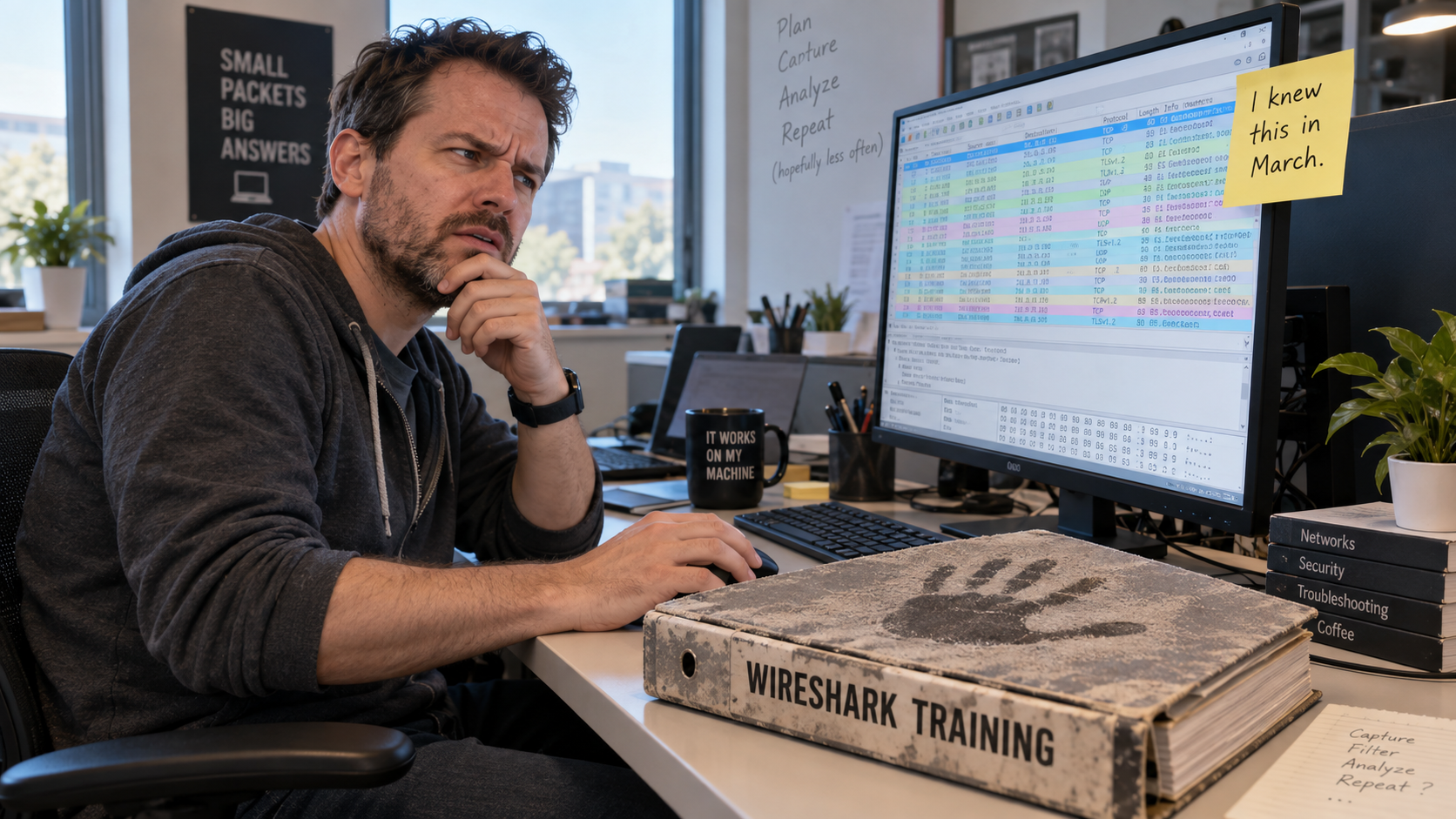
Your team took the Wireshark course. The exercises made sense. You could follow a TCP stream, explain a handshake, and find the relevant display filter. Then everyone went back to identity management, backups, cloud migrations, and support tickets.
Months later, an application slows down. Someone collects a packet capture. You open it, see thousands of packets, and realize you remember what a retransmission is, but not how to decide whether it explains this incident.
For a generalist responsible for many systems, packet analysis may be a small part of the job until an incident makes it urgent. A company can need dependable packet investigation even when individual administrators rarely do it.
Knowing the concepts and knowing where to start
A training exercise usually gives you a question, a suitable capture, and enough context to begin. A production ticket might give you “the application is slow,” a timestamp without a timezone, and a file captured after the problem stopped.
Before a display filter helps, you need to decide which client, transaction, connection, and time window matter. You need to know where the capture was taken and what that location can show. A trace on the client side of a proxy cannot directly explain everything happening behind it.
The difficult part is choosing and testing an explanation. Finding a filter for retransmissions is straightforward. Establishing whether the retransmitted bytes delayed the affected request requires a timeline and context.
For an occasional user, the incident can become two jobs at once: investigate the fault and rebuild enough familiarity to investigate it well. That extra work belongs in the team's incident plan, alongside access, capture permissions, and escalation contacts.
A red packet is a lead, not the answer
Imagine an illustrative incident where a user waits five seconds for a response. The capture contains a retransmission, so it becomes the first suspect.
Now isolate the affected transaction. Suppose the retransmission belongs to a different connection. On the relevant connection, the request reaches the observed server endpoint, its bytes are acknowledged, and most of the delay occurs before the first response bytes appear.
That changes the next question. The capture supports investigating the wait beyond that observation point. It does not identify a slow database query, prove that the application consumed the request immediately, or rule out every downstream network problem. TCP acknowledgments establish transport receipt, not completion of application work.
The useful result is a narrower investigation with evidence for the next team. Someone who is out of practice may need help reconstructing those steps, even while understanding every individual protocol term. Our application troubleshooting guide develops this timing-based approach.
When one person becomes the packet-analysis department
A team may have a dependable fallback: send the capture to the colleague who works with Wireshark regularly. That is a sensible escalation path. It becomes fragile when every case needs that person to reconstruct the incident from the beginning.
“Can you look at this PCAP?” leaves the specialist to discover the symptom, find the relevant flow, establish the capture location, and decide which observations matter. If the colleague is unavailable, the capture can sit untouched while the incident continues.
The organization also loses reusable knowledge when the answer survives only in a chat message. The next administrator inherits the file, but not the reasoning that made it useful.
Training costs are one part of this problem, covered separately in Do All Your Admins Need to Become Wireshark Experts?. Here the question is readiness: what remains available to the team between the course and the next incident?
Leave the next investigator a worked case
A small collection of approved, well-explained cases gives occasional users somewhere concrete to restart. Choose cases relevant to the systems your team supports, and handle the captures according to your data policies. Anonymization needs review; changing addresses alone does not establish that a capture is safe to share.
Each worked case should preserve:
- The question: the reported symptom, affected system, and time window.
- The capture context: collection point, direction, filters, and known gaps.
- The reasoning: the first lead, an alternative explanation, and what distinguished them.
- The evidence: exact frames, fields, and timing that support the conclusion.
- The outcome: the next action, what confirmed the fix, and anything still unknown.
A list of display filters helps with recall. A worked case also shows when to use them and how to interpret the result. Include an inconclusive case so that asking for a better capture is treated as a useful outcome.
Revisit these cases periodically in a short team exercise. Let someone other than the original author explain the conclusion from the retained evidence. If they cannot follow it, improve the case while there is time to do so. This is a suggested practice, not a guaranteed schedule for retaining expertise.
Make the first response repeatable
Occasional investigators benefit from a short capture playbook they can use before they remember every Wireshark feature. Record the affected client and service, the symptom, the timestamp and timezone, the capture location, and whether the problem occurred during collection.
Then establish a simple sequence: validate the capture, find the relevant conversation, build a timeline, test a candidate explanation, and decide what evidence is missing. The PCAP analysis workflow provides a starting point.
Define escalation conditions in advance. These might include missing handshake packets, encrypted application exchanges that cannot answer the question, conflicting observations from different capture points, or a conclusion whose supporting packets nobody can explain. Escalation should carry those limits forward.
Where assisted investigation can help
This is a practical role for PacketSafari's root-cause investigation workflow: help an administrator move from an unfamiliar capture to a candidate explanation connected to packet evidence, with the limits and next steps available for review. The administrator still supplies the incident context and checks whether the evidence answers the actual question.
A Preliminary Report provides direction. Verification is a separate step, and a plausible explanation should not become a production change merely because it sounds confident. Keep the relevant packets available for inspection in the Analyzer or Wireshark, and use the packet evidence verification standard to assess the conclusion.
For the example above, useful assistance would identify the relevant exchange, show where the elapsed time accumulated, and explain why the unrelated retransmission does not establish the cause. It would also state what the capture cannot reveal about the service behind the observed endpoint.
Evaluate assistance on representative cases from your own environment. Can an occasional user explain the result? Can the specialist follow the evidence without starting over? Does the workflow recognize when another capture or application logs are needed? Those are more useful checks than the fluency of the generated report.
Build capability that survives the gap
Engineers who investigate packets regularly need depth, practice, and good tools. Generalists need enough understanding to collect useful evidence, question an explanation, and recognize when to escalate. The same training and maintenance plan will not fit both roles.
If your team opens Wireshark twice a year, plan for the gap between those occasions. Preserve worked cases, make capture collection repeatable, and give the next investigator an evidence-backed starting point. The goal is for the company to remain capable when the person opening the capture is out of practice.