
Do All Your Admins Need to Become Wireshark Experts?
 Oliver Ripka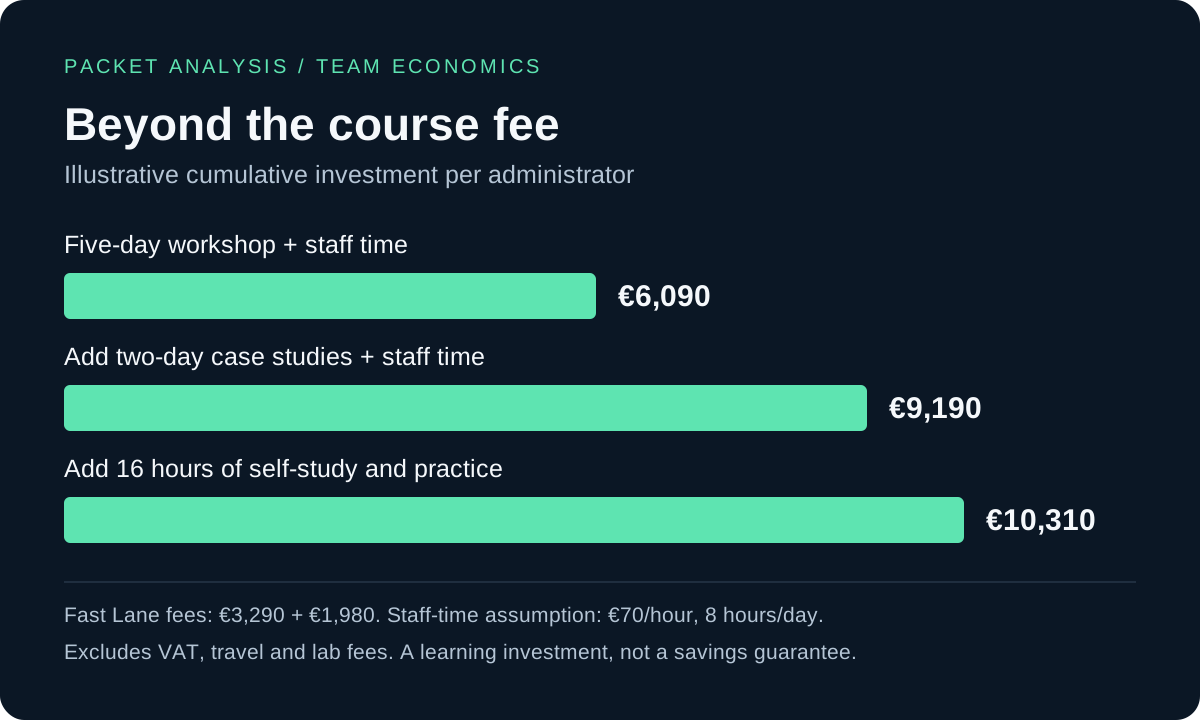
Wireshark training can cost more than €6,000 per administrator once you include time away from other work. The harder question is how often that administrator will use the skill. A network specialist opening captures every day has a different need from a generalist troubleshooting packets once a month, or twice a year.
For the occasional user, the business problem extends beyond learning filters. It includes rebuilding familiarity during an incident, deciding which packet symptoms matter, and waiting for a senior engineer when the answer remains unclear. PacketSafari's value proposition is to help that administrator reach a reviewable explanation with less specialist effort.
What a week of packet-analysis training costs
There is no single mandatory route to learning Wireshark. Free resources, self-study, mentoring, and shorter courses all have a place. For a concrete instructor-led example, Fast Lane's Packet Analysis Power Workshop lists five days at €3,290 excluding VAT in Germany. It combines introductory and advanced packet-analysis material.
Its listed follow-on, Real-World Wireshark Case Studies, adds two days at €1,980 excluding VAT. It is a case-study workshop for people with prior knowledge, not an automatic qualification as an expert. As another reference point, ExperTeach's Wireshark Protokollanalyse course lists five days at €2,995 excluding VAT in Germany.
These are published examples checked on September 11, 2026, not a market average. Prices, delivery formats, and group discounts can change.
Consider one administrator whose loaded working time is valued at €70 per hour, with eight working hours allocated per training day. Those are planning assumptions, not provider claims about teaching hours or salary benchmarks.
| Investment per administrator | Calculation | Modeled cost |
|---|---|---|
| Five-day Fast Lane workshop | Published course fee | €3,290 |
| Working time allocated to that week | 5 × 8 hours × €70 | €2,800 |
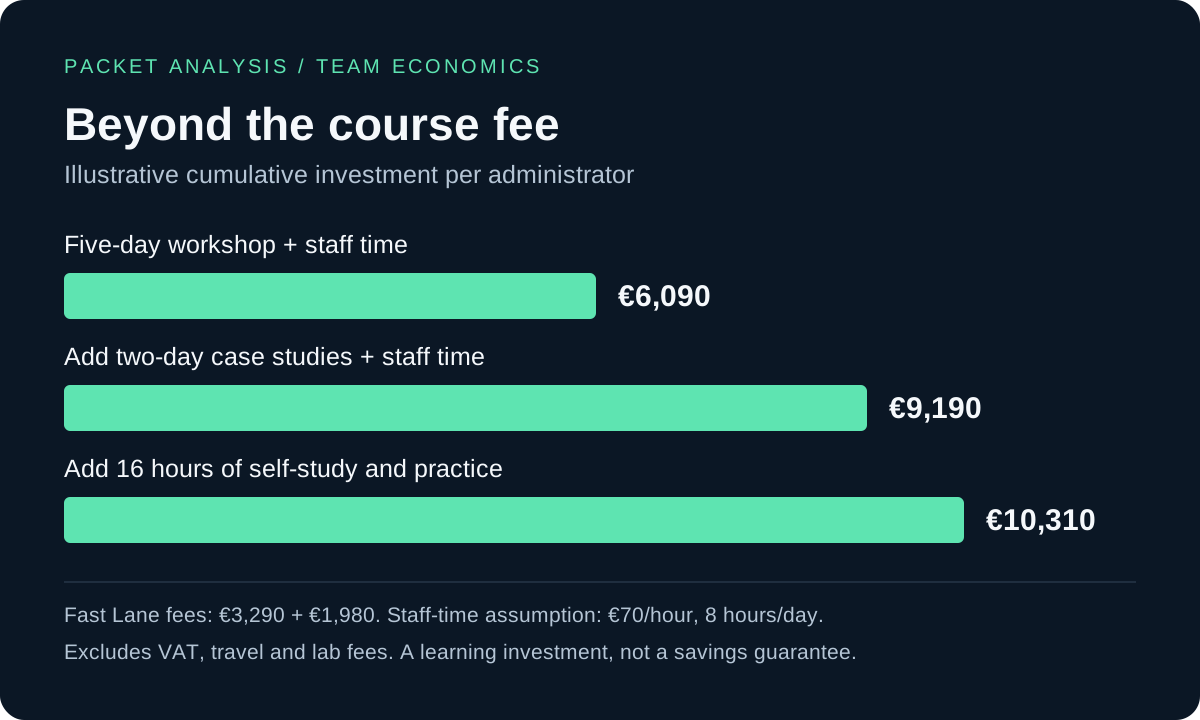
| Initial week, including staff time | €3,290 + €2,800 | €6,090 |
| Optional two-day case-study workshop | Published course fee | €1,980 |
| Working time for the follow-on | 2 × 8 hours × €70 | €1,120 |
| Seven-day path, including staff time | €6,090 + €1,980 + €1,120 | €9,190 |
| Illustrative additional self-study and labs | 16 hours × €70 | €1,120 |
| Path with that practice allowance | €9,190 + €1,120 | €10,310 |
The initial week already exceeds €6,000 in this model. At €50 per hour it would be €5,290; at €90 it would be €6,890. Replace the hourly input with your own figure before using the result in a budget.
The totals exclude VAT, travel, accommodation, and any separately purchased lab or certification access. Staff time represents capacity committed to learning, not an additional course invoice. The 16-hour practice allowance is illustrative, not a promise of proficiency.
Completing a course and staying fluent are different jobs
A course can teach an administrator how TCP recovery works. An unfamiliar production capture asks more: did recovery actually delay this transaction, did the capture miss packets, and which side of a proxy does the evidence describe?
That judgment develops through varied cases and practice. Wireshark Labs provides hands-on PCAP exercises and questions for self-paced learning. I co-created the platform with Chris Greer because practical analysis deserves time alongside instruction. The Wireshark learning resources provide further routes into training and study.
Now consider an administrator who completes a course, then spends six months on identity, backups, endpoint management, and cloud operations before the next packet investigation. They may need to revisit filters, graphs, and protocol behavior while an incident is already in progress. That is a planning risk for an infrequently used skill, not evidence that the course was wasted or that every learner forgets on a fixed schedule.
The choice is how much specialist fluency each role needs to maintain. Training remains valuable for engineers who investigate regularly and for the specialists who review difficult cases.
The senior-engineer bottleneck matters more than the course invoice
When the first responder cannot confidently interpret a capture, the case moves to someone more experienced. That senior engineer must reconstruct the question, find the relevant transaction, and separate a plausible story from what the packets prove.
An assisted investigation should make that handoff more focused. Instead of sending a large capture with “the network seems slow,” the administrator can bring a candidate explanation, the relevant flows, supporting frames, and the remaining uncertainty. Sometimes that is enough to resolve the case. Sometimes it gives the specialist a better starting point.
Here is a separate, illustrative evaluation target, not a measured PacketSafari result:
| Staff effort per case | Existing workflow | Assisted workflow target |
|---|---|---|
| Administrator at €70/hour | 4 hours: €280 | 1 hour: €70 |
| Senior reviewer at €110/hour | 2 hours: €220 | 0.5 hours: €55 |
| Total effort value | €500 | €125 |
If validated, the difference would be 4.5 staff hours and €375 of capacity per case, before software and operating costs. Across the whole team, two cases a year would represent €750; twelve would represent €4,500. The assisted time must include capture preparation, checking the answer, reporting, and any remaining escalation.
Count administrator and reviewer hours separately only when they are separate work. Include onboarding, deployment, and integration costs in the business case. Already-completed training is a sunk cost, and released staff time does not automatically reduce payroll. Measure downtime effects separately rather than assigning every saved analysis hour the full cost of an outage.
What an administrator should still understand
Reliable root-cause work needs a useful capture and a reviewable conclusion. The administrator should be able to describe the symptom and time window, collect traffic from an appropriate location, handle sensitive data correctly, and recognize when the result needs further evidence.
PacketSafari supports that work through evidence-backed network root-cause investigation. The useful output connects a finding to packets, flows, timing, or decoded fields and makes the visibility boundary explicit. A Preliminary Report gives early direction; it should not be treated as a verified conclusion. The packet evidence verification guide explains the review standard.
For example, a capture may support a long service-side wait after request delivery. It may not reveal which database query or internal application component caused the wait. Identifying that boundary and the next evidence can still move the incident forward. An unsupported definitive answer cannot.
Fit the investigation into the tools you already use
The workflow can start with a monitoring alert, a support ticket, or an application incident. Your capture tool or packet recorder supplies the relevant PCAP. PacketSafari investigates that evidence, and the team brings the findings back into the incident workflow. Wireshark remains available for detailed manual inspection.
This is the place PacketSafari occupies in the wider toolchain. A PCAP export and a human handoff are a valid starting point. Automated ingestion, case-system updates, authentication, and deployment requirements should be scoped and verified for the particular integration rather than assumed from a product name.
Evaluate against your team's actual incidents
Choose representative cases and compare the manual baseline with assisted investigation. Record time to useful evidence, correctness, senior-review effort, misleading conclusions, and what could not be established. Include cases where the packets cannot answer the whole question.
For frequent packet analysts, training and practice remain a strong investment. For occasional users, evaluate whether guided investigation lets them resolve more cases and escalate the difficult ones with better evidence. The objective is to reduce how often a routine incident requires a specialist to start from scratch.
Your administrators should not all need to become packet-analysis specialists to get a defensible answer. Talk to PacketSafari about a tailored SaaS or enterprise offer, based on your investigation volume, deployment needs, and existing tools. Bring a representative capture and the question your team needs to answer.