
Packet Evidence Verification: A Practical Standard
 Oliver Ripka
Packet evidence verification answers a harder question than “does this conclusion sound plausible?” It asks whether another analyst can retrieve the same packets, inspect the same fields and sequence, understand the capture boundary, and reach a compatible conclusion without trusting the original author.
That is the standard enterprise packet investigation should meet. A fluent summary is not evidence. A red alert icon is not evidence. Even a correct Wireshark analysis flag is a hypothesis until the surrounding packets and capture conditions support it.
What counts as actionable packet evidence
Actionable evidence connects an observation to a decision. It normally contains five parts:
- Selector: how to retrieve the relevant traffic, such as a filter, stream, tuple, time window, or transaction ID.
- Anchor: exact frames, timestamps, decoded fields, and bytes that show the event.
- Context: the packet sequence before and after the anchor, including direction and protocol state.
- Coverage: what traffic, time, interfaces, and analysis methods were included or absent.
- Interpretation: the supported conclusion, plausible alternatives, confidence, and next check.
Remove any one of these and the result becomes harder to use. A frame number without the capture is not reproducible. A filter without a conclusion is only navigation. A conclusion without coverage may overstate what was examined.
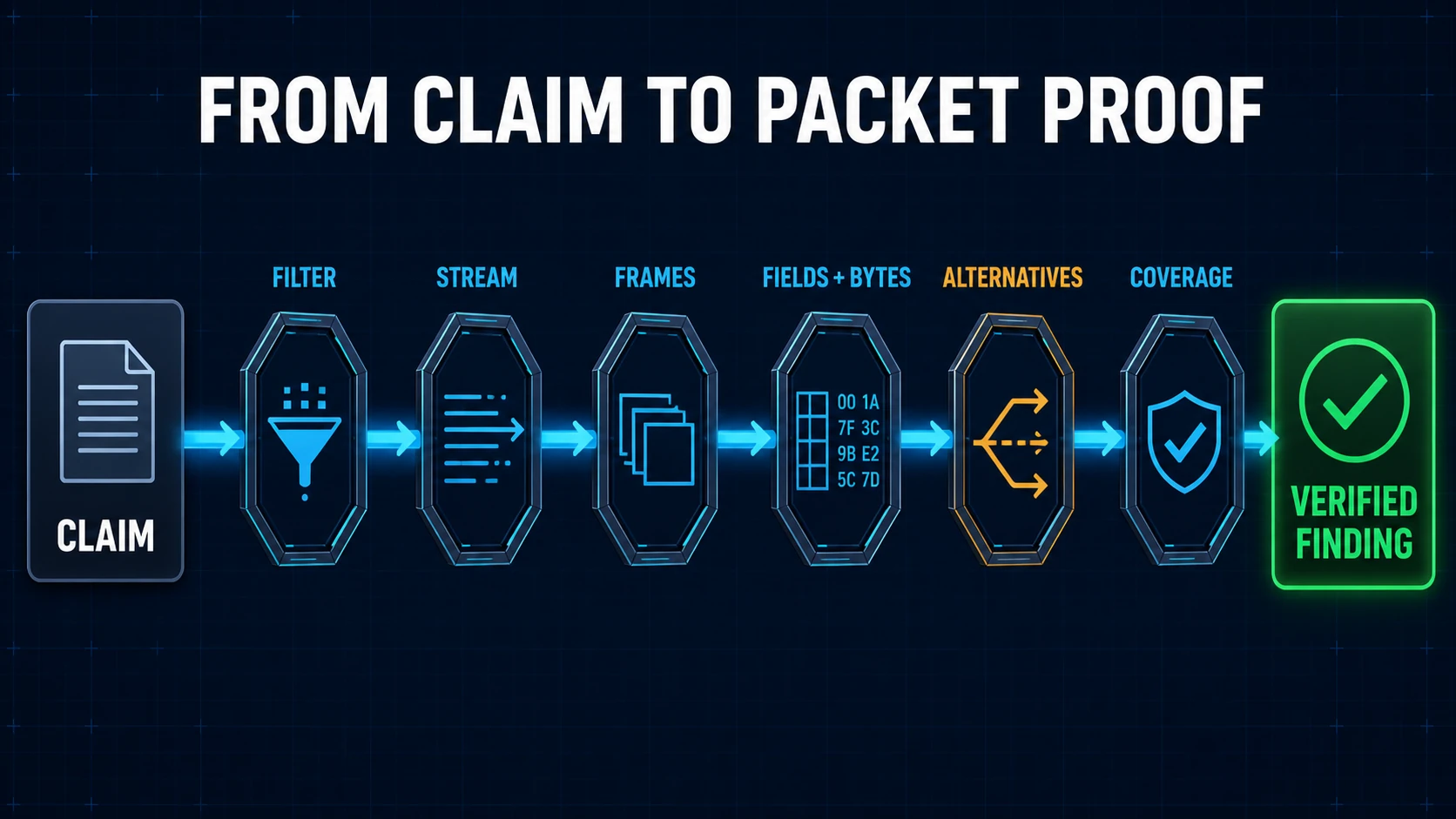
Verification is a chain. A conclusion is only as reviewable as its weakest evidence gate.
Observation, signal, issue, and finding are different
Teams often collapse several reasoning stages into one label. Keeping them separate prevents premature certainty.
| Stage | Example | What it means |
|---|---|---|
| Observation | Frame 1227 contains a TCP RST from the server-side address | A directly decoded fact in the visible capture |
| Signal | The reset follows a ClientHello in three failed attempts | A repeatable pattern worth investigating |
| Issue candidate | A server-side or intermediary component may be terminating TLS | A causal explanation consistent with some evidence |
| Finding | The capture supports termination on the server-facing path, with the responsible device still unproven | An interpreted conclusion with an explicit boundary |
The finding should cite the observations and explain how the signal was tested. It should not silently upgrade “reset seen from this IP address” into “this host generated the reset.” NAT, asymmetric visibility, proxies, load balancers, and spoofed or rewritten traffic can break that inference.
The exact-evidence packet
For each material conclusion, preserve a compact evidence packet:
Question: Why did the TLS session fail?
Selector: ip.addr == 192.0.2.25 && tcp.stream == 42
Anchors: frames 812-819
Observation: ClientHello at 814; RST/ACK toward the client at 819
Baseline: streams 38 and 44 complete the handshake through the same capture point
Coverage: both directions visible; no capture drops reported; payload encrypted
Interpretation: a server-facing component terminated this attempt after ClientHello
Alternative retained: an intermediary may have emitted or rewritten the reset
Next check: capture simultaneously before and after the load balancer
This is short enough for an incident ticket and precise enough for a packet specialist.
Verify the capture before verifying the theory
A conclusion cannot be stronger than the capture boundary. Record:
- physical or logical capture position
- interfaces included in PCAPNG
- capture and display filters
- packet slicing or snap length
- reported packet drops
- timestamp source and synchronization
- NIC offloading or aggregation effects
- encryption and missing key material
- expected traffic that the capture point could not observe
Capture loss can imitate network loss. A one-sided capture can make a successful response look absent. A SPAN port can duplicate or reorder packets. An endpoint capture can show offloaded segments that never appeared on the wire in that form.
These are not reasons to abandon the trace. They are reasons to qualify the answer.
Test at least one serious alternative
Verification is not repeating the same analysis with a different tool. It should try to disprove the preliminary conclusion.
Suppose the first pass says packet loss caused an application stall. A useful verification asks:
- Does the sender actually retransmit the same byte range?
- Did the receiver acknowledge the original data before the retry?
- Is a SACK block visible?
- Could the original or acknowledgment be missing only from the capture?
- Does the retry align with the user-visible stall?
- Do comparable successful flows show the same analysis flags?
- Is server think time a better explanation for most of the delay?
An independent check may adopt the first conclusion, qualify it, rebut it, or declare the capture inconclusive. All four are valid outcomes.
What different tools contribute
“Network analysis” can mean packet inspection, graph analysis, security monitoring, or digital forensics. The tools are not substitutes simply because they all display relationships.
- Wireshark and TShark decode exact packets, fields, streams, and statistics. They are excellent verification instruments when the analyst knows what to inspect.
- tcpdump and dumpcap acquire and filter the packet record. Their evidence value depends on capture position and collection quality.
- Zeek turns network activity into structured logs that can identify the session and behavioral context, while the original PCAP remains the frame-level record.
- Arkime indexes sessions and can retain and export their packets, making it easier to retrieve the bounded evidence set.
- Suricata contributes signatures, protocol events, anomalies, and file evidence. A rule match should be verified in its packet and incident context.
- NetworkMiner recovers hosts and transferred artifacts that may clarify what happened at the application layer.
- Autopsy is primarily a digital-forensics platform for disk and related evidence. It may belong in the same case, but it is not a direct replacement for packet decoding.
- Graph tools such as Neo4j, Gephi, Cytoscape, or Graphistry can reveal entity relationships. Their graph is only as reliable as the events and identities used to build it.
- PacketSafari combines capture-wide Triage, bounded Agent investigation, exact packet anchors, and a separate Verification milestone for the selected PCAP.
The 2026 packet analysis tools comparison maps these roles in more detail. The practical lesson is to preserve the handoff between them: alert to session, session to packets, packets to conclusion, conclusion to response.
A useful conclusion has a stopping rule
Analysts sometimes keep searching because the PCAP cannot name the failing device with certainty. A good stopping rule distinguishes three outcomes:
- Proven within the capture: the packet sequence directly establishes the event and responsible endpoint at the observed boundary.
- Best-supported direction: one explanation fits better than its alternatives, but another capture point or system log is required for attribution.
- Inconclusive: missing visibility or contradictory evidence prevents a defensible choice.
“Inconclusive” is not a failed analysis. It prevents a weak theory from becoming an expensive change request.
Review checklist
Before calling a packet conclusion verified, ask:
- Can another analyst retrieve the cited packets with the supplied selector?
- Are observation and interpretation written separately?
- Does the packet sequence include enough context before and after the event?
- Is the capture position and quality boundary explicit?
- Was a comparable success or another baseline checked when available?
- Was at least one plausible alternative tested?
- Does the conclusion avoid attributing behavior beyond the observed boundary?
- Are remaining uncertainty and the next check stated plainly?
The practical PCAP workflow shows how to build this evidence during an investigation rather than reconstructing it afterward.
PacketSafari uses this standard to keep preliminary direction, independent Verification, and the Final Report distinct. To test it with your own case, evaluate PacketSafari with a representative capture and verify the material findings against the cited frames yourself.