
Suricata Alert Verification with Packet Evidence
 Oliver Ripka
A Suricata alert is a strong lead, but it is not automatically a completed incident conclusion. To verify one, preserve the original alert, locate the relevant packets or flow in the PCAP, compare that traffic with the rule's actual conditions, reconstruct the surrounding transaction, and report both what the signature matched and what the evidence says about the threat.
This distinction matters wherever analysts receive more alerts than they can manually investigate. It matters even more in defence, law enforcement, critical infrastructure, and other sensitive or disconnected environments where packet data may not be allowed to leave the local network.
PacketSafari complements Suricata by turning the alert and its surrounding capture into an evidence-backed investigation. The goal is not to replace the IDS. It is to help an analyst answer the next questions: Did the rule really match the recorded traffic? Does the wider exchange support malicious activity? What exact packets justify that assessment? What remains unknown?
What a Suricata alert proves
Suricata evaluates network traffic against signatures, protocol parsers, flow state, and other detection logic. When it emits an alert, it tells you that the configured rule conditions were satisfied by what the sensor observed.
That is valuable evidence. It does not, by itself, prove:
- that an intrusion succeeded
- that the activity was malicious rather than authorized or accidental
- that the affected host was compromised
- that the alert covers the full incident
- that the capture contains enough context for a definitive assessment
- that the rule was evaluated with the intended variables, exceptions, and rule-set version
A signature can match correctly and still describe expected administrative traffic. Conversely, a suspicious exchange may be incomplete because the capture started late, ended early, dropped packets, or observed only one side of an asymmetric route.
The right question is therefore not only “Is this alert true or false?” A better investigation separates three issues:
- Rule match: Can the relevant traffic and rule condition be reproduced from the available evidence?
- Threat assessment: Does the surrounding behavior support malicious, benign, or expected activity?
- Evidence sufficiency: Is the capture complete enough to make that assessment confidently?
Preserve the alert before starting PCAP analysis
Keep the original EVE JSON event with the PCAP whenever possible. Suricata's EVE JSON format provides fields that can bind an alert to the observed traffic, including timestamps, addresses, ports, protocol, flow identifiers, alert metadata, and, for PCAP processing, packet counters.
Useful fields commonly include:
timestampflow_idpcap_cnt, when present- source and destination IP addresses and ports
- protocol and application protocol
alert.signature_id, revision, signature, category, and severity- sensor identity and capture interface from the surrounding system
Also preserve the PCAP filename and hash, the rule-set or ET Pro version, the sensor configuration, the time zone, and any known capture limitations. These details prevent a later investigation from silently evaluating a different rule, a different file, or a different point in the network.
Suricata can also process stored captures offline with its PCAP file options. That is useful for reproducible testing, but replaying a file is not a substitute for examining the exact traffic and deployment context behind the original event.
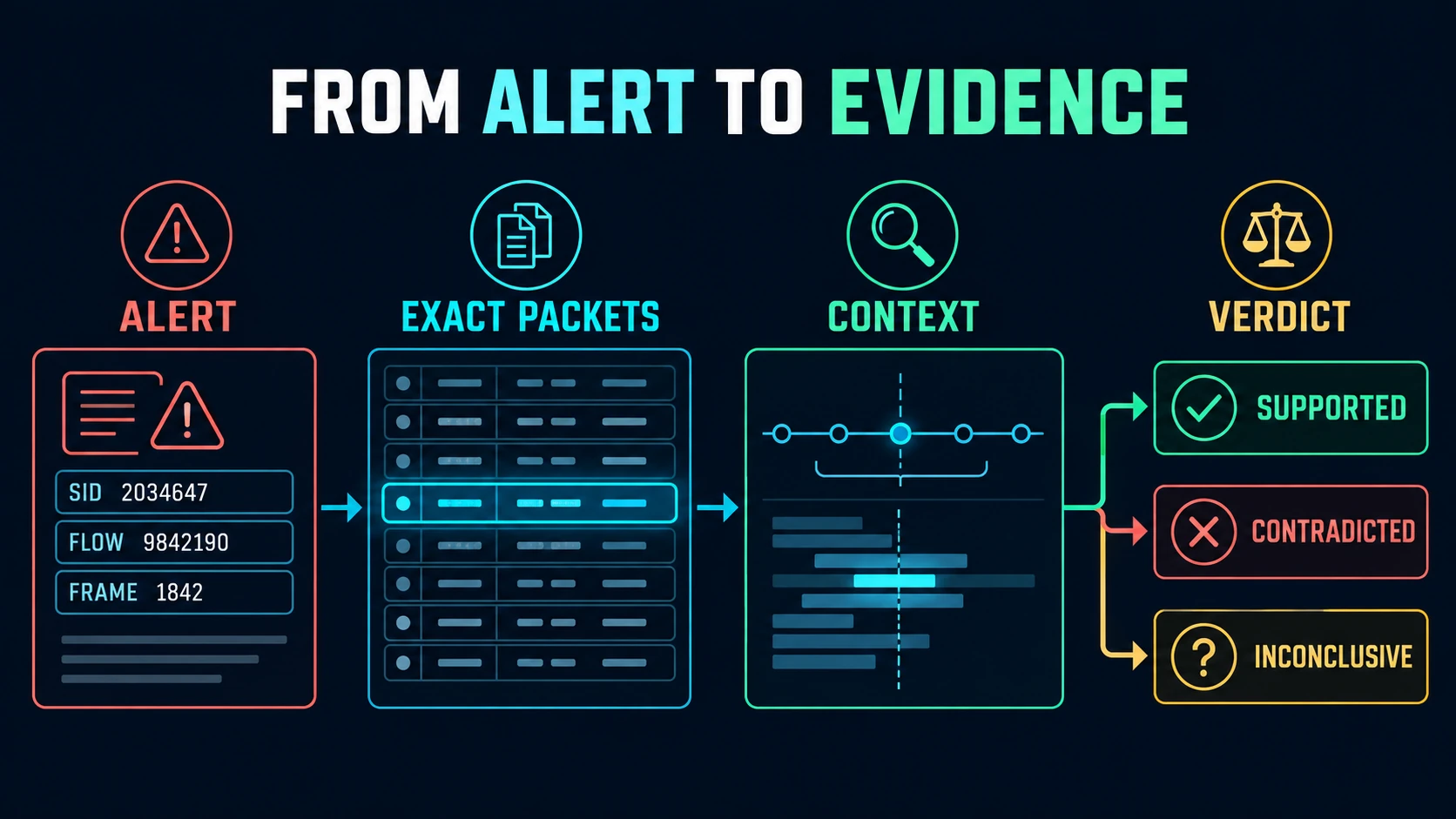
A useful verification path remains traceable from the conclusion back to the alert, flow, and exact packet frames. Missing evidence remains visible as an inconclusive result rather than being forced into a yes-or-no answer.
A repeatable alert-verification workflow
1. Identify the exact event and rule
Start with the full event, not a screenshot or shortened ticket title. Resolve the signature ID and revision against the rule set that was active on the sensor. Read the complete rule, including flow direction, content modifiers, protocol keywords, thresholds, and referenced variables.
An alert description may sound more definitive than the rule logic. The rule itself is the detection contract.
2. Bind the alert to packets and a flow
Use the timestamp, five-tuple, flow_id, packet counter, and application metadata to find the relevant traffic. Do not rely on the timestamp alone when a busy capture contains many simultaneous connections.
Record the original frame numbers or equivalent stable packet references. If the PCAPNG contains multiple interfaces, retain the interface identity as well. Those anchors allow another analyst to reproduce the finding.
3. Reconstruct the surrounding transaction
The triggering packet is rarely the whole story. Reassemble the TCP stream or relevant application exchange and inspect what happened before and after the match:
- How was the destination resolved?
- Who initiated the connection?
- Did a handshake and application transaction complete?
- Was the request accepted, rejected, or reset?
- Did the same behavior repeat?
- Did another protocol or connection immediately follow?
For UDP and other connectionless traffic, build the smallest time-bounded exchange that preserves request and response context.
4. Compare evidence with the rule semantics
Explain which bytes, fields, state, or sequence satisfy each important rule condition. If the capture does not reproduce the condition, investigate why. Possible causes include packet loss, stream normalization differences, encrypted content, a different rule revision, offloading artifacts, or an alert generated from traffic outside the supplied file.
“Not reproduced” is not automatically “false positive.” It is a specific finding that needs its own explanation.
5. Test plausible benign explanations
Compare the activity with asset role, approved scanners, vulnerability-management windows, software-update infrastructure, backup systems, and known administrative workflows. A confirmed signature match can still be benign or expected in that environment.
The inverse also matters. Familiar infrastructure should not automatically make suspicious traffic safe. The assessment must remain tied to observable behavior.
6. Check capture coverage
Record whether the file contains both directions, the complete flow, the relevant capture point, adequate snap length, and acceptable packet loss. If decisive payload is encrypted or missing, say so. Recommend the next bounded evidence source, such as endpoint telemetry, another network tap, the TLS termination point, or a longer capture window.
Keep the rule match and threat assessment separate
A single boolean loses too much information for incident response. Consider these examples:
| Rule match | Threat assessment | Meaning |
|---|---|---|
| Confirmed | Likely malicious | The rule matched, and the wider traffic supports harmful or unauthorized activity. |
| Confirmed | Benign or expected | The detector worked, but context supports an approved or harmless explanation. |
| Not reproduced | Inconclusive | The supplied capture does not reproduce the event, and the reason is not established. |
| Unverifiable | Inconclusive | Missing, encrypted, truncated, or one-sided evidence prevents a defensible conclusion. |
This structure avoids calling every technically correct match a “true positive” and every unproven alert a “false positive.” It also gives detection engineers useful feedback without overstating what the network evidence can prove.
Three practical verification examples
Repeated outbound callback
Suppose an Emerging Threats rule fires on an outbound HTTP pattern. The triggering request is present in the PCAP, and the same internal host contacts the destination repeatedly at regular intervals. DNS activity, connection timing, headers, and follow-on exchanges support an automated callback rather than ordinary browsing.
The report can mark the rule match as confirmed and the threat assessment as likely malicious. It should cite the exact frames, show the repeated sessions, state which behavior supports the conclusion, and avoid claiming host compromise unless the evidence establishes it.
Authorized security scanning
An exploit-related rule fires during a scheduled internal assessment. Packet reconstruction confirms that the payload matched the signature exactly. The source is an approved scanner, the timing matches the change record, and the destination returns an error without evidence of successful exploitation.
Here the rule match is confirmed, while the threat assessment is benign or expected in context. That does not make the Suricata rule defective. It may mean the rule needs local suppression, tagging, or workflow enrichment for this scanner and schedule.
Incomplete capture around a high-severity alert
An EVE event identifies a suspicious TLS flow, but the supplied capture begins after the handshake and contains only server-to-client packets. The alert may be valid, but the PCAP cannot establish the requested client behavior or the server name.
The defensible result is unverifiable and inconclusive. The report should identify the missing direction and recommend retrieving the original sensor capture or collecting at a point that observes both sides. Severity should not pressure an analyst into inventing certainty.
Plain-language input can be enough
For the dedicated event-submission workflow, including structured EVE JSON, independent verification, and report export, follow Suricata alert verification through the UI, CLI, and API.
An automated investigation does not need a complicated form for every ticket. A headless PacketSafari investigation can start with a PCAP and a precise plain-language instruction:
packetsafari run incident.pcap \
  "Verify Suricata SID 2034647. It fired at 2026-09-10T09:42:18Z on 10.24.8.17:51432 to 198.51.100.27:443. Determine whether the rule match is supported, assess the surrounding traffic, cite exact frames, and state any evidence gaps."
For production automation, retain the complete EVE event rather than converting everything into prose. A ticketing or SOAR integration can attach the original structured alert, the capture reference, and the analyst's question. The plain-language string remains useful for intent, while structured fields reduce ambiguity when locating the event.
A useful machine-readable result should keep outcomes distinct:
{
  "rule_match": "confirmed",
  "threat_assessment": "likely_malicious",
  "confidence": "medium",
  "evidence": [
    { "frame": 1842, "finding": "Triggering request matches the rule condition" },
    { "frame": 1907, "finding": "Same flow receives an application response" }
  ],
  "limitations": ["No endpoint telemetry was supplied"],
  "recommended_action": "Isolate the source host and correlate with process activity"
}
The exact CLI or API contract should be qualified against the PacketSafari release and deployment being evaluated. Authentication, service-account scope, idempotent retries, retention, and report delivery are deployment concerns, not details to improvise inside each SOAR playbook.
Why on-premises and air-gapped analysis matters
Sensitive networks often cannot upload packet captures to a public cloud. The captures may expose internal addressing, operational systems, identities, credentials, mission details, or regulated data. In an air-gapped environment, even a well-designed hosted service may be outside policy.
An on-premises AI deployment can keep the PCAP, deterministic packet processing, model inference, evidence, and generated reports within the controlled boundary. This can support defence and public-safety workflows, industrial networks, laboratories, and other environments with strict data-handling requirements.
Local deployment is not automatically ready for every environment. The exact hardware, model, release, authentication configuration, rule sources, and workload sizes still need a bounded evaluation. Teams should test representative malicious, benign, and incomplete captures and confirm that reports remain reproducible under their operational constraints.
What PacketSafari adds to the IDS workflow
Suricata remains the high-throughput detector. PacketSafari adds the investigation layer around the alert:
- deterministic capture inventory and protocol facts
- focused retrieval of the packets behind a finding
- reconstruction of flows and surrounding network context
- AI-assisted hypothesis testing and explanation
- independent verification of important claims
- reports with packet references, limitations, and next actions
This approach also connects alert review with broader malicious traffic analysis and security-control validation. The same workflow can show that a detector fired correctly, that a control blocked the attempted action, or that the supplied capture cannot answer the question.
Packet evidence does not remove the need for analyst judgment. It makes that judgment inspectable.
Evaluate the workflow with your own alerts
A useful evaluation should include at least three cases:
- A known malicious or simulated event where the decisive traffic is present.
- A benign activity that triggers the same or a similar signature.
- A deliberately incomplete capture that should produce an inconclusive result.
Measure whether the workflow identifies the correct event, cites the right frames, separates rule matching from intent, recognizes missing evidence, and produces a report another analyst can reproduce. Also measure processing time, resource use, and behavior with concurrent tickets on the intended on-premises hardware.
For a broader methodology, read How to Find Malicious Traffic in a PCAP and Packet Evidence Verification. To evaluate this workflow for a sensitive or disconnected environment, request a PacketSafari demonstration.