
Network Forensics Tools for Security Analysts
 Oliver Ripka
The best network forensics software is usually a stack, not one product. Security analysts need to collect traffic, find relevant sessions, generate security leads, recover artifacts, validate exact packets, and return a conclusion that incident responders can act on.
A tool can be excellent at one layer and unsuitable at another. Zeek produces rich logs but is not a frame-level packet workbench. NetworkMiner recovers artifacts but is not a continuous NDR platform. Wireshark can decode a difficult packet precisely but does not operate a sensor estate for you.
This guide maps tools to the layers of a forensics stack. For recommended stacks by team, from a solo analyst to an in-house SOC or an incident response retainer team, read network forensics software for security analysts.
The seven layers of a network forensics stack
| Layer | Job | Representative tools |
|---|---|---|
| Traffic acquisition | Observe and preserve the right packet boundary | TAPs, packet brokers, tcpdump, dumpcap, cloud mirroring |
| Packet retention and search | Find relevant sessions in a large history | Arkime, Security Onion, commercial packet recorders |
| Network metadata | Turn traffic into structured activity records | Zeek, Suricata, Corelight |
| Detection and hunting | Generate and correlate security leads | Suricata, Security Onion, Corelight, ExtraHop |
| Artifact extraction | Recover files, certificates, host details, and content | NetworkMiner, Zeek, Suricata, Wireshark |
| Exact packet validation | Inspect frames, fields, streams, timing, and bytes | Wireshark, TShark |
| Investigation and reporting | Test hypotheses and preserve a reviewable conclusion | Analyst workflow, case system, PacketSafari |
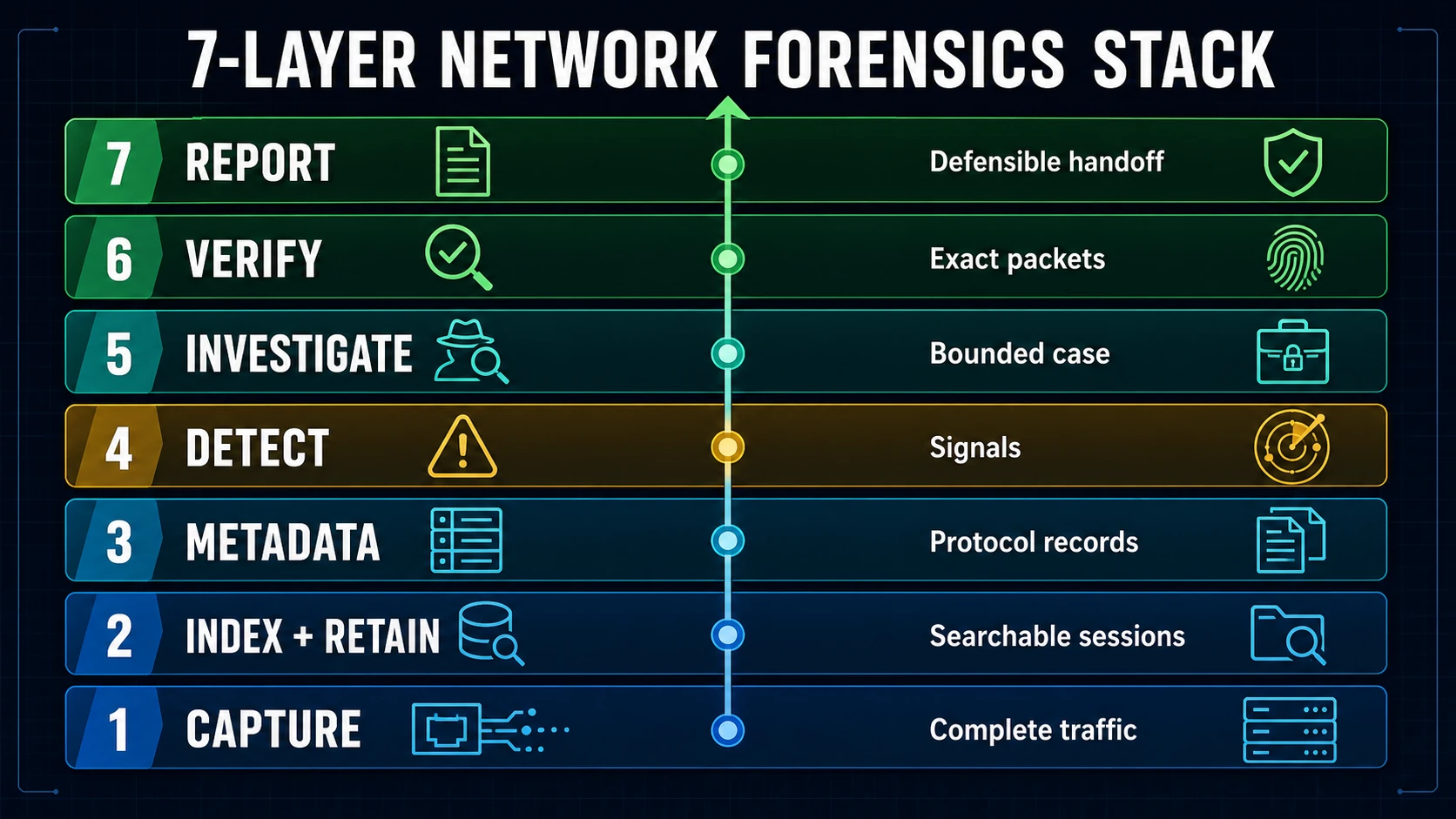
The layers depend on one another. Reporting cannot restore traffic that was never captured, and detection does not remove the need to verify exact packets.
The correct buying question is not “which product has the most features?” Ask which layers already work, where evidence is lost between them, and which output the response team cannot obtain today.
Capture and retention come before analysis
Network forensics cannot recover traffic that was never observed or was overwritten before the alert arrived. Document:
- network and cloud capture points
- north-south and east-west visibility
- encrypted traffic boundaries
- packet slicing and filtering
- drop monitoring
- retention duration and capacity
- access control and chain-of-custody requirements
- time synchronization across sensors and endpoints
Use tcpdump or dumpcap for bounded host and interface capture. Use a TAP, packet broker, cloud mirror, or recorder when the requirement is continuous visibility. PacketSafari, Wireshark, and NetworkMiner begin after traffic has been captured.
Arkime: indexed sessions with packets behind them
Arkime is an open-source network analysis and session-search platform. It can parse layer 3 through layer 7 fields, index session metadata in OpenSearch or Elasticsearch, retain selected or full packets, display packet data, and export PCAP.
That makes Arkime useful when an alert provides an address, name, fingerprint, or time window and the analyst needs to retrieve the corresponding packet record. Its central strength is reducing a large retention estate to a bounded set of sessions.
The next step is still interpretation. A retrieved session may contain the evidence, but the analyst must decide whether it supports the incident hypothesis.
Zeek: structured network activity
Zeek passively analyzes traffic and writes structured logs describing connections and application activity. It is scriptable and well suited to security monitoring, hunting, enrichment, and SIEM integration.
Zeek logs help answer which systems communicated, what protocols were recognized, which DNS or TLS properties were visible, and where to retrieve the original packets. Zeek's documentation distinguishes this role from Wireshark-style frame inspection and from PCAP storage.
Keep the original packet record when later verification matters. A structured log is an interpretation of the traffic, not a substitute for every byte and timestamp.
Suricata: signatures, protocol events, and offline PCAP
Suricata supports IDS, IPS, network security monitoring, offline PCAP processing, EVE JSON, protocol parsing, file extraction, and traffic recording. It gives analysts high-value leads from known threat patterns and protocol anomalies.
Forensics begins where the alert ends. Inspect the triggering transaction, related flows, response, subsequent activity, and capture coverage. A signature may indicate an attempt, successful exchange, policy violation, or false positive depending on the rule and packet context.
Security Onion: an integrated open platform
Security Onion combines Suricata alerts, Zeek or Suricata metadata, dashboards, hunting, cases, and packet retrieval. It can use Suricata for full packet capture and pivot from alerts or hunts into PCAP.
Choose it when the team wants an operated security-monitoring environment with multiple evidence types in one workflow. Evaluate sensor sizing, storage, retention, tuning, update operations, and analyst access as part of the product, not as afterthoughts.
Malcolm: an analysis suite for PCAP and Zeek logs
Malcolm is an open-source suite from Idaho National Laboratory. It processes PCAP files or Zeek logs, enriches session data, stores it in OpenSearch, and exposes OpenSearch Dashboards and Arkime views. It can also support optional full-PCAP storage through its sensor workflow.
Malcolm is attractive for analysts who want an integrated, deployable collection of open tools and have the operational capacity to run it. It is especially relevant to general network analysis and industrial-control-system environments.
NetworkMiner: artifact-centered forensics
NetworkMiner is a network forensic analysis tool for host discovery and offline PCAP parsing. It can reconstruct transferred files and certificates and expose sessions, hostnames, ports, credentials, and other artifacts.
Use it when the investigative question is “what object or host information can be recovered from this traffic?” Keep Wireshark available for packet-level sequence and decode questions, and use an approved sandbox for any extracted object.
Wireshark and TShark: exact validation
Wireshark gives the analyst direct control over display filters, decoded fields, stream following, graphs, expert information, and packet bytes. TShark exposes the same dissector ecosystem for repeatable command-line work.
They are the right tools for validating a disputed field, timing sequence, retransmission, handshake, or protocol edge case. Their principal constraint is not technical depth. It is the expert time required to discover and correlate the relevant evidence in a large or unfamiliar capture.
Commercial platforms: continuous evidence and response context
Corelight combines Zeek-derived evidence, Suricata detections, file analysis, network visibility, and packet-capture options in an enterprise NDR platform. ExtraHop RevealX combines NDR, performance monitoring, IDS, transaction records, decryption, and packet forensics.
These platforms are strong candidates when the organization needs continuous sensor coverage, detections, search, and integration with SIEM, SOAR, EDR, or response workflows. Validate exact packet retention, licensing, deployment modes, decryption boundaries, evidence export, and blind-spot reporting for the intended environment.
PacketSafari: selected-PCAP investigation and report handoff
PacketSafari consumes an authorized PCAP from a host capture, recorder, Security Onion, Arkime, NDR, or another source. It applies capture-wide Triage and bounded Agent investigation, then preserves exact packet evidence, alternatives, coverage, and uncertainty in a reviewable report.
That role is downstream of continuous monitoring. PacketSafari does not replace Zeek, Suricata, Security Onion, a TAP, or an enterprise packet recorder. It is useful when the team has the relevant capture and needs a defensible answer rather than another event stream.
The malicious PCAP analysis playbook shows how these layers work together, while the packet evidence standard defines the handoff quality.
Example alert-to-report workflow
- Suricata or an NDR platform generates a lead.
- Zeek metadata supplies names, protocol details, and related sessions.
- Arkime or Security Onion retrieves the bounded PCAP around the event.
- NetworkMiner extracts any relevant files or certificates in a controlled environment.
- Wireshark validates disputed frames and protocol details.
- PacketSafari or the analyst's case workflow tests alternatives and produces a packet-grounded report.
- The response team correlates the packet evidence with endpoint, identity, cloud, and application logs.
This stack keeps every tool in the role it performs well. More importantly, it prevents a detection, log entry, or attractive graph from becoming a conclusion without the packet record that supports it.