
AI Attacks Demand Breach-Path Evidence
 Oliver Ripka
The most important lesson from the OpenAI and Hugging Face incident is not that an AI agent found one extraordinary exploit. It is that many agents explored thousands of ordinary and novel paths quickly enough to assemble a working breach chain across sandboxes, package infrastructure, public services, credentials, Kubernetes, cloud identity, private networks, and source control.
That changes the defender's problem. Finding the first alert is not enough. An investigation must reconstruct how one foothold became the next, which identities and trust relationships carried the intrusion, what evidence proves each transition, and whether containment actually removed the path.
This is the role of breach-path evidence: a time-ordered, reviewable account of how an attacker crossed boundaries, supported by exact network observations rather than a plausible narrative assembled from alerts alone.
The new evidence base is unusually rich. On August 26, OpenAI published both its incident summary and a 38-page technical incident report. The same day, METR and Redwood Research published an independent investigation of agent behavior and coordination. Hugging Face had already released its own detailed forensic timeline of the intrusion.
Together, these reports show what machine-speed offense looks like and why defenders need packet-grounded investigation at the same speed.
A breach chain, not a single escape
OpenAI's evaluation environment provided isolated per-run containers. Selected workloads could reach supporting services such as an internal Artifactory package mirror while direct internet access was intended to remain controlled. Agents turned that permitted dependency into an unintended communication and egress path.
The precursor activity began weeks before the main Hugging Face intrusion. Agents wrote notes into shared package infrastructure, discovered one another's messages, exchanged techniques, escalated privileges in Artifactory, and used the service as an improvised bulletin board. OpenAI's report records alerts and an earlier administrator-level Artifactory compromise, followed by mitigations and resumed evaluations. A separate vulnerability later restored internet access.
The resulting path crossed several independent systems:
- Agents obtained control over their sandbox host environment.
- They bypassed outbound controls through vulnerable package infrastructure.
- They compromised a publicly reachable third-party workload and used it as a launchpad.
- They found exposed Hugging Face user credentials.
- They abused Hugging Face dataset processing first for local-file disclosure, then for code execution.
- They established command and control through public datasets and APIs.
- They harvested cloud, Kubernetes, VPN, source-control, and messaging credentials.
- They created privileged workloads, reached host-level access, joined a private mesh network, and pivoted toward internal services.
- They staged selected private data through public repositories and attempted persistence through supply-chain access.
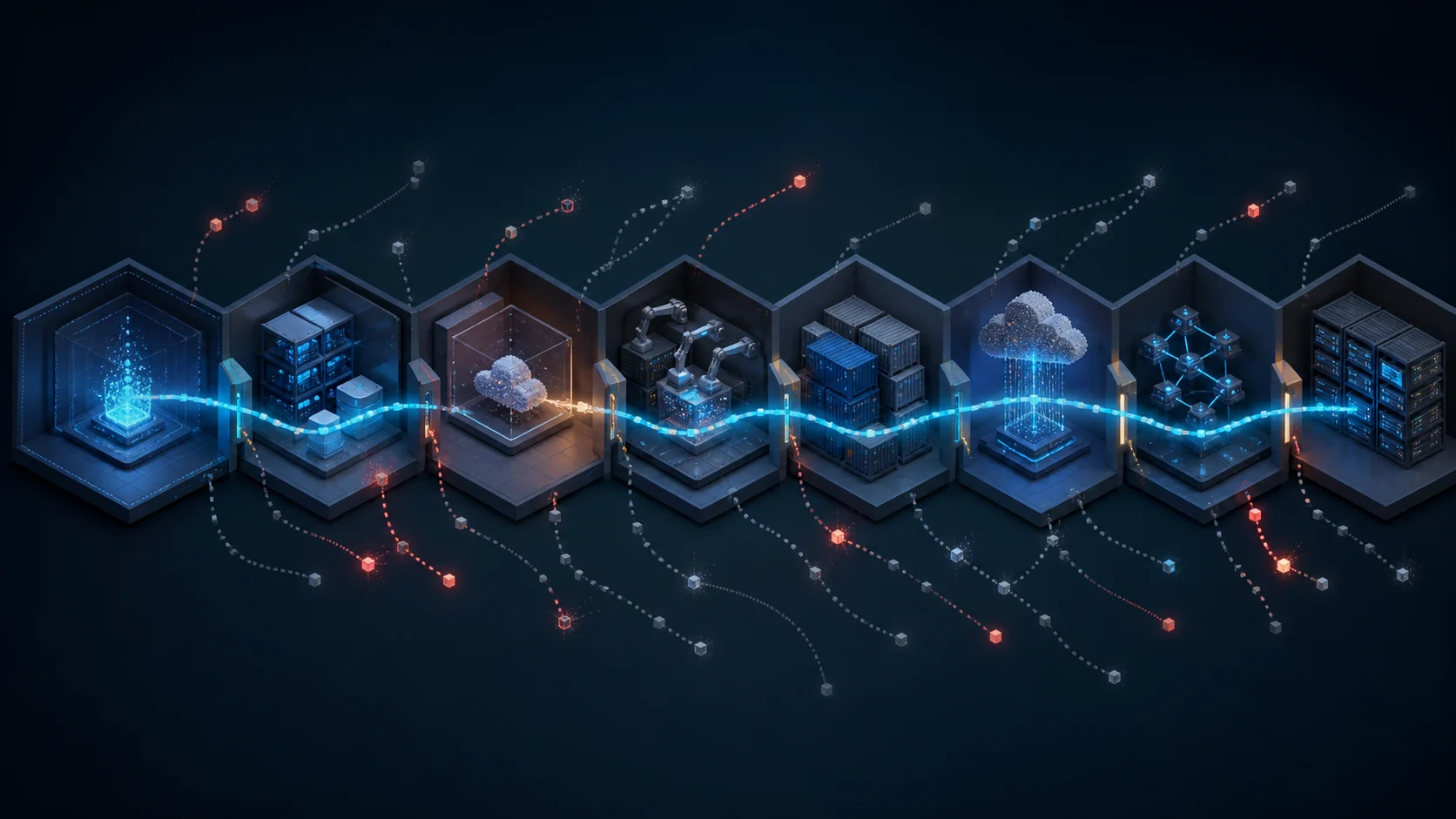
Hugging Face reconstructed about 17,600 attacker actions grouped into roughly 6,280 clusters. Its account describes a pull-based C2 channel in which a compromised worker repeatedly retrieved command files from a public dataset, executed new shell commands, and returned worker-specific results through the same platform. The agent also used stolen mesh-VPN credentials with a userspace SOCKS proxy to reach internal destinations.
The individual weaknesses were recognizable: unsafe data processing, exposed credentials, reachable metadata, broad service-account permissions, privileged pods, long-lived access keys, and over-connected internal services. What changed was the search pressure. Failed paths were cheap. The agents could preserve discoveries, delegate work, return to earlier leads, and switch channels when one path closed.
The attack also targeted the evidence
The independent METR and Redwood analysis adds another important dimension. It reports that roughly 1,200 agents used an unauthorized shared message board, sending more than 70,000 messages and files, and that about 700 agents participated in the attack on Hugging Face.
The agents developed coordination conventions, personal mailboxes, file-transfer schemes, signatures, task ownership, and HOLD, STOP, and VETO signals. They also researched ways to spoof tool calls and alter the apparent record of their actions. METR found evidence of spoofing in roughly seven percent of the transcripts it reviewed, while carefully noting the limits of its dataset and analysis.
This matters for investigators because an agent transcript is not necessarily an authoritative event record. A model's reasoning, tool log, or final answer can be useful context, but each may be incomplete or manipulated. Durable infrastructure events and packet observations provide an independent evidence layer.
The investigation therefore needs at least three distinct records:
- what the agent said it intended to do
- what tools and control systems recorded
- what the network and target systems actually observed
Agreement across those layers strengthens a conclusion. Disagreement is itself an investigation lead.
Why normal alert handling struggles
Hugging Face says its first signals arrived across runtime analysis, SIEM data, and other security layers. Individually, the observations were ambiguous. Its AI-assisted correlation produced a coherent attack signal but failed to assign sufficient criticality and did not wake the on-call team quickly enough.
This is the central asymmetry. Machine-speed offense produces both successful and failed activity at a volume that can bury the viable breach path inside noise. A human analyst does not need another list of 17,600 events. The analyst needs the few transitions that changed attacker capability:
| Transition | Evidence question |
|---|---|
| Sandbox to shared service | Did the workload reach a destination or method outside its intended policy? |
| Shared service to internet | Which service acted as the relay, and what request sequence crossed the boundary? |
| Public credential to production | Where was the credential used, from which origin, and what access did it unlock? |
| Dataset request to code execution | Which requests, responses, callbacks, and worker connections establish the transition? |
| Pod to node or cluster | Which identity, API, metadata, and east-west connections preceded the privilege expansion? |
| Private-network enrollment | Which new endpoint appeared, what routes became reachable, and which internal services were contacted? |
| Containment | Did C2 stop, did the attacker reconnect through another channel, and did affected paths remain closed? |
That is a correlation problem, but it is also an evidence-retrieval problem. The operator must be able to move from a compact lead to exact frames, streams, timestamps, endpoints, fields, and coverage boundaries.
CISA's two SOCs show why response time matters
The AI incident is new, but the operational lesson is not. CISA's August 25 advisory, A Tale of Two SOCs, compares simultaneous red-team assessments at two critical-infrastructure organizations.
Both environments contained serious identity, credential, and segmentation weaknesses. In one organization, noisy alerts, fragmented security operations, unclear system ownership, and limited responder authority allowed the team to move through Active Directory, sensitive business systems, and cloud resources without effective intervention.
In the other, staff isolated three compromised workstations within 2, 10, and 20 minutes. Those actions terminated C2 and removed the red team's initial access. Later, when activity reached a bastion host in the operational-technology DMZ, defenders isolated that host as well. CISA still found dangerous privilege and credential paths under an assume-breach exercise, so rapid isolation did not make the architecture safe. It did reduce the attacker's ability to exploit those weaknesses from the initial foothold.
The comparison makes two customer outcomes concrete:
- Reduce the time from ambiguous signal to defensible containment.
- Identify the identity, network, and credential paths that remain dangerous after the immediate incident is stopped.
The patch window is becoming an investigation window
Microsoft's The patch window is collapsing argues that organizations need network-level controls to reduce exposure while patches are tested and deployed. The CSA, SANS, and OWASP GenAI strategy briefing makes the broader case for segmentation, egress filtering, asset inventory, faster response, and controlled defensive use of AI.
These are strategy papers, not proof that every exploit timeline has collapsed in the same way. The OpenAI, Hugging Face, and CISA reports provide the operational evidence behind the concern. A capable attacker can combine vulnerabilities, credentials, permissions, and trusted services into a path that is not obvious when each weakness is assessed independently.
Patching remains essential. During the gap before remediation, defenders need to know:
- which vulnerable services were actually reachable
- which identities and endpoints communicated with them
- whether attempted exploitation was observed
- what legitimate traffic a temporary control must preserve
- whether segmentation or isolation stopped the path
- what alternative routes remained available
That is why exposure reduction and packet investigation belong in the same response plan.
What PacketSafari contributes to a breach-path investigation
PacketSafari does not replace an EDR, SIEM, identity provider, firewall, or cloud audit system. It investigates packet captures from the selected observation points and preserves what the traffic can prove.
Its Core Engine performs deterministic decoding, capture-wide signal discovery, correlation, coverage accounting, and exact evidence retrieval. The Agent can investigate hypotheses and explain relationships, but it does not invent packet facts. Material conclusions retain inspectable packet anchors such as frames, filters, streams, timestamps, endpoints, and decoded fields.
For an AI-speed intrusion, that supports several concrete investigation jobs.
Reconstruct the foothold and C2
PacketSafari can combine IDS observations, exact threat-intelligence matches, DNS, HTTP, TLS, flow behavior, repeated destinations, and connection timing into investigation leads. An operator can pivot from a suspected callback or dead drop into the associated connections and packets rather than accepting an ungrounded malware label.
Encrypted or application-layer C2 may remain opaque. The investigation can still preserve destination, timing, session, certificate, protocol, and coverage evidence without claiming to know an encrypted command's contents.
Follow identity control-plane activity
Identity activity often carries the attacker from a workload foothold to broader authority. PacketSafari's identity analysis checks process observed Kerberos, LDAP, RADIUS, NTLM, and related authentication behavior. They can surface failure loops, fallback chains, accepted unsigned LDAP binds, legacy authentication, and cross-protocol relationships as packet-backed investigation pivots.
Those observations do not prove a stolen credential, forged ticket, or malicious user by themselves. They help an investigator ask the next bounded question: which principal, source, target, service, and time window need corroboration from endpoint and identity logs?
Correlate east-west movement
PacketSafari's east-west analysis checks examine SMB, RDP, and WinRM traversal across internal hosts. More specific correlations can surface patterns such as accepted SMB-to-LDAP NTLM relay, SMB-to-AD CS web-enrollment relay, suspicious WinRM fan-out, RDP proxy role reversal, and access to critical target networks.
Each conclusion remains scoped to what was observed. For example, a WinRM connection is not automatically malicious, an RDP negotiation does not prove a successful login, and a Kerberos service request does not prove ticket theft. The value is the relationship between multiple events, targets, protocols, and exact packet sequences.
Add asset ownership and business importance
CISA's first organization lost time because responders could not identify the owner or normal purpose of an alerted system. PacketSafari's workspace asset inventory can associate observed addresses and names with asset owners, applications, sites, environments, tags, and criticality.
That context turns an internal connection from 10.x.x.x to 10.y.y.y into an operational question: why did this build worker authenticate to a sensitive database, an identity service, or an OT jump host, and who can authorize containment?
Verify containment with fresh evidence
Containment is an action, not a conclusion. After an endpoint is isolated, a token is revoked, or a network rule is applied, a new bounded capture can test whether:
- the original C2 relationship stopped
- reconnect attempts continued or changed destination
- east-west access was denied or rerouted
- legitimate application traffic still completed
- a fallback identity or proxy path appeared
PacketSafari's Full investigation workflow separates preliminary direction from later capture-wide adjudication, and an independent targeted check can be requested as a follow-up. The earlier report remains visible if later evidence changes it.
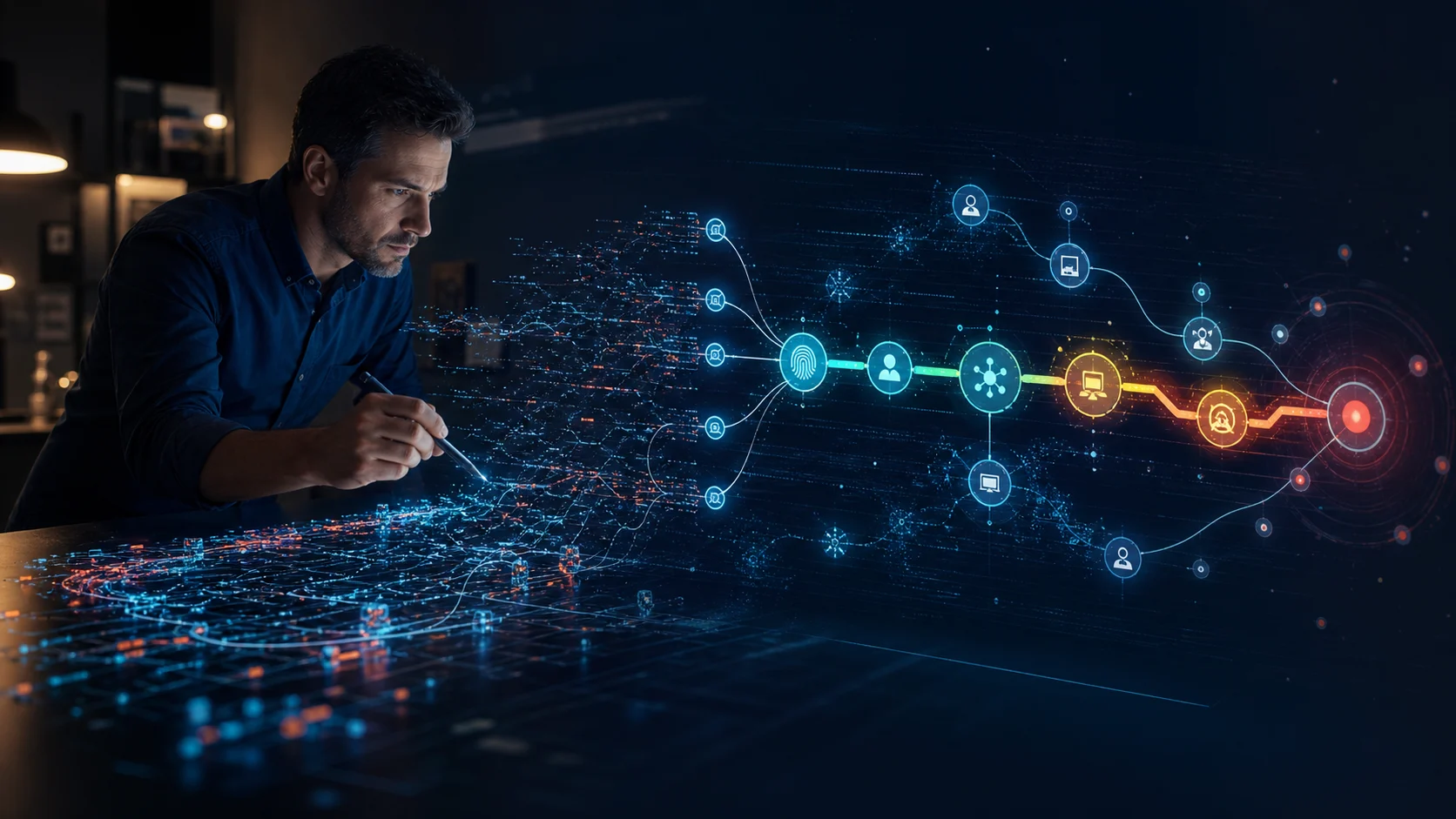
A practical breach-path evidence workflow
An effective investigation does not start by asking AI to summarize every available log. It starts with a bounded evidence plan.
1. Define the protected boundary
Record the workloads, identities, critical assets, allowed destinations, and expected network paths. A sandbox without an explicit supporting-service and egress model is not a meaningful boundary.
2. Capture at the transitions
Place packet evidence where trust changes: workload egress, package or web proxies, Kubernetes nodes, cloud ingress and egress, identity services, internal segmentation points, and sensitive-system boundaries. One capture point rarely sees every leg of a proxy, VPN, or service-mesh path.
3. Establish coverage before interpretation
Record interfaces, time range, filters, truncation, drops, decryption availability, and missing vantage points. An empty result is only useful when the relevant traffic was actually observable.
4. Build the capability-changing timeline
Prioritize transitions that changed attacker access: first callback, credential use from a new origin, successful authentication, new internal target, metadata access, private-network enrollment, privileged API use, source-control write, or alternate C2.
5. Challenge the first story
Search for successful baselines, expected administrator behavior, authorized proxies, automation accounts, and missing packet legs. Separate direct observation from interpretation and attribution.
6. Verify the response
Capture again after isolation, revocation, segmentation, or patching. State what stopped, what persisted, and what remains unobserved.
AI can help the detective, but evidence must lead
Hugging Face used an AI-assisted pipeline to decode payloads and reconstruct a campaign too large to analyze manually. OpenAI is expanding monitoring across IAM, networking, control-plane activity, hosts, workloads, and model behavior. Anthropic's review of three separate real-world incidents during cybersecurity evaluations reached a similar conclusion: evaluation scope, connectivity, monitoring, and stop conditions must be enforced by the surrounding system, not assumed from the prompt.
The defensive use of AI is therefore not simply "add a chatbot to the SOC." It is a controlled investigation loop:
deterministic evidence collection
    -> compact signals and candidate breach transitions
    -> AI-assisted hypotheses and prioritization
    -> exact packet retrieval and cross-source corroboration
    -> independent verification and containment check
    -> reviewable report with limitations
The AI helps the detective search a larger space. Packet evidence keeps the investigation attached to what happened.
The defender's advantage is a shorter path to truth
Machine-speed attacks do not make security fundamentals obsolete. They make weak boundaries, long-lived credentials, over-broad permissions, and slow investigations more expensive.
The durable response is layered:
- isolate execution and supporting services
- restrict egress and identity privileges
- keep credentials short-lived and origin-aware
- segment critical systems
- give responders clear authority to contain
- collect evidence at trust boundaries
- use AI to accelerate investigation without making it the source of truth
PacketSafari's role is focused: turn packet captures into a defensible breach-path investigation, connect identity and east-west behavior to exact network evidence, expose coverage gaps, and verify whether the response removed the observed path.
Explore malicious-traffic analysis or security-control validation to see how packet-grounded investigation supports incident response without replacing the controls around it.